Read time: 3 minutes / Subscribe to this newsletter
Hello Friend,
It was Friday afternoon. A peer dropped a request on Anna: Can you get me the pricing details on those facilities by Tuesday?
Anna said yes. Immediately. Without thinking.
She forgot, though, that she was out on Monday.
What she didn’t know, because she hadn’t asked, was that the request required her to connect with a hard-to-reach third party to pull the actual numbers together. And when she did, that person came back with questions Anna couldn’t answer. What format? What’s the scope? What’s this for?
She didn’t fully know. Because she’d never asked in the first place.
So she went back to her peer. Got partial answers. Went back to the third party. Got more questions. Back to her peer again. Two days of ping-pong, all because one word left her mouth before her brain caught up.
That word was “yes.”
The Yes That Isn’t Really Yes
Here’s what most people misunderstand about being easy to work with.
They think it means being agreeable. Saying yes. Being available. Keeping people happy.
But in my forthcoming book Unignorable, I make the case that being easy to work with is actually about removing friction. Not creating it. And a reflexive yes? That creates friction every single time.
Because when you say yes before you understand the ask, you’re essentially faking confidence. You take on a task without the context to execute it. And then that gap between what you committed to and what you actually understand shows up later as back-and-forth, rework, and delayed delivery. The person who asked you for help ends up doing more work, not less. That’s friction.
Anna wasn’t saying yes because she wanted to do the work. She was saying yes because she wanted to be dependable. She wanted people to count on her.
But a yes you can’t deliver isn’t dependability.
The “Real Yes” Framework
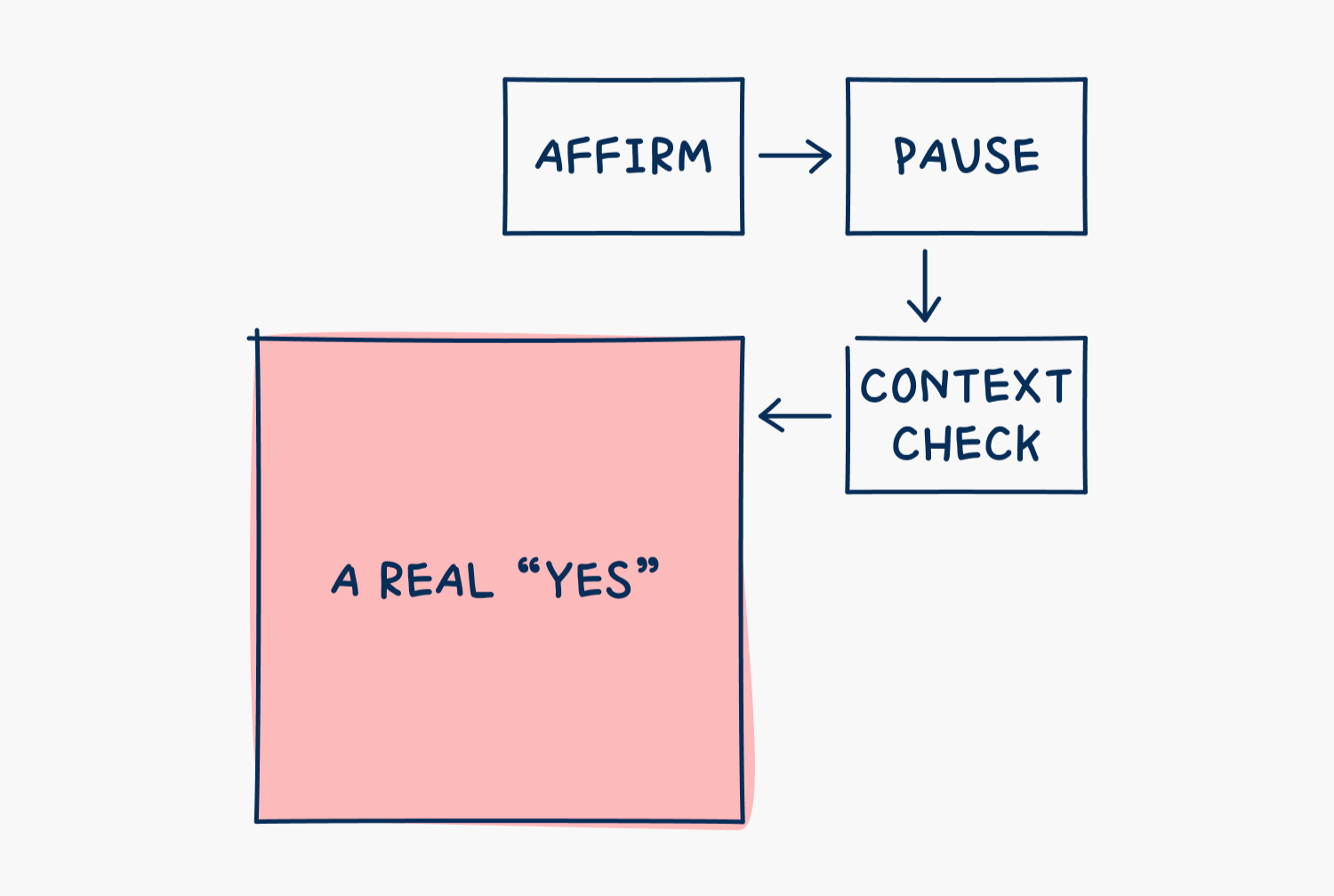
In my coaching work, I’ve been testing a simple three-step approach that converts the reflexive yes into something actually useful: a real yes.
Here’s how it works:
1. Affirm
Instead of yes, try: “I can help with that.”
Five words. They signal you’re in. But they don’t lock you into a scope you haven’t fully heard yet.
2. Pause
Follow the affirm immediately with: “I want to make sure I do this well. Can I get a little more context?”
This isn’t stalling. This is protecting your ability to deliver. And psychologically? Asking for more information signals to the other person that you genuinely care about the outcome, not just the transaction.
3. Context Check (What / So What / What’s Next)
Before you commit to a deadline or a deliverable, run through three fast context questions:
What: What exactly is needed? Format, data points, specifics.
So what: Why does this matter? What’s the objective?
What’s next: What will they do with this when they have it?
Once you’ve answered those questions, here’s the most important step. Ask yourself: Can I realistically deliver this? Is this the right use of my time right now?
If the answer to both is yes, now you have a real yes.
(If the answer to either one of them is no, you likely need to tactfully push back. I’ll cover how to do that in next week’s newsletter.)
I made this into a one-page cheat sheet.
[👉 Download the Real Yes Framework here]
Print it. Keep it at your desk. Pull it up before your next meeting. You won’t need it forever, but you might need it more than once.
Your Unignorable Move
Anna eventually got the information to her peer. The work got done.
But what stayed with her wasn’t the task. It was the embarrassment of going back and forth when a few questions upfront would have prevented all of it.
She told me, “I thought saying yes was how I showed people they could depend on me. I didn’t realize it was actually making me look less dependable.”
That reframe is available to you right now.
Your coach,
Chris
P.S. If you’re working on the reflexive yes habit and want someone in your corner, I’d love to connect. That’s what coaching is for.