Why good ideas don’t land…
Read time: 3 minutes / Subscribe to this newsletter
Hello Friend!
Recently, I was talking to a brilliant entrepreneur.
She has an amazing background with a career trophy case that would make Tom Brady look like a lightweight.
She worked at multiple Fortune 500 companies. Track record of being a top producer in most of those career stops. And the personality of someone who’s pretty easy to love.
But she’s been struggling mightily since launching her own business last year.
She’s developed a product that many people need. It’s well-designed and could create a meaningful transformation for her customers.
But… no one is buying.
Many of us have been in this same situation ourselves. Whether we’re a corporate insider trying to sell our ideas to colleagues or an entrepreneur trying to break through in the market.
Sometimes, it feels like we’re hitting a wall. And no one seems to be buying what could so obviously solve the problem they’re experiencing.
They Don’t Care About Your Solution (Yet)
Returning to the entrepreneur, something strange happened when we initially spoke.
Even though I fully understood her background and the ideal client she was targeting, I could not get my head around what she was selling.
She was using a lot of insider language and jargon that I did not understand. But more importantly, I didn’t know what problem she was even solving. Zero context.
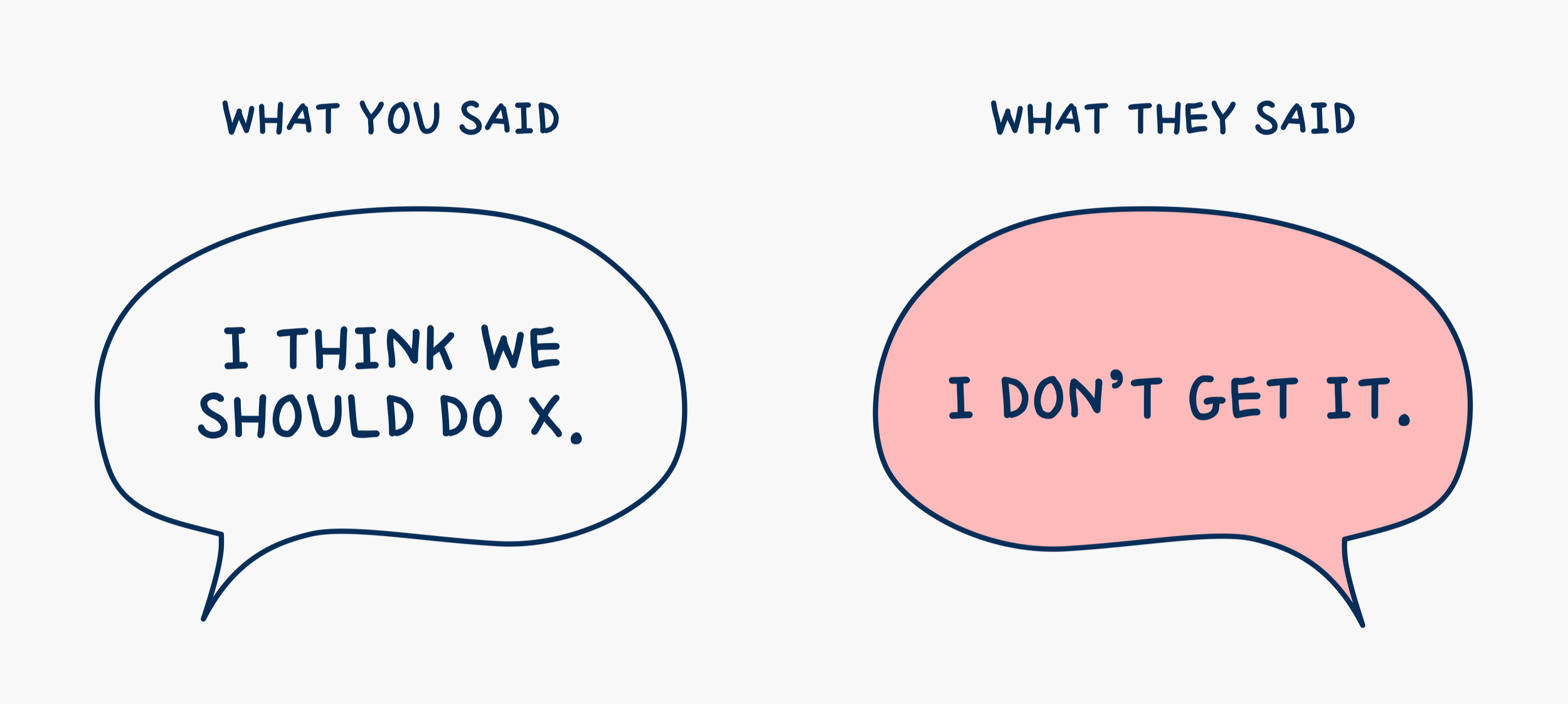
And therein lies the problem. When we’re trying to sell an idea, a product, or a service, we often jump right to the solution. We assume our audience has enough context to understand how our solution can help.
They don’t.
And so, when we’re done pitching or presenting… It’s crickets. Nothing moves forward. They don’t take action. And your amazing idea just dies.
This doesn’t need to happen. I’m going to give you a simple tool that’ll help you build the proper context with your audience so they know exactly what problem you’re trying to solve.
This will prime them for a productive conversation about your idea or solution.
I call it the “Shouldn’t Have To” formula.
The “Shouldn’t Have To” Formula
Let me demonstrate it first, then I’ll coach you on it.
Quick quiz… what products am I describing below?
You shouldn’t have to visit a store or pay late fees to watch a movie.
You shouldn’t have to own music to enjoy it.
You shouldn’t have to send 12 emails to schedule a meeting.
My guess is that you quickly identified these three products. Netflix. Spotify. Calendly.
Now let’s imagine how a tech salesperson might’ve sold these same products:
“Netflix is a personalized content delivery model with thousands of titles and proprietary algorithms.”
“Spotify is a next-generation audio streaming platform leveraging cloud infrastructure to deliver on-demand playback.”
“Calendly offers an automated scheduling solution with calendar integration and timezone detection.”
Horrible.
Do you see the difference? In those latter sales pitches, it was a solution-forward description that would’ve meant very little to you the first time you ever heard about the company.
But it’s more powerful to use a problem-forward pitch instead.
Use the structure of the “Shouldn’t Have To” formula to do this. It looks like this:
[Target audience] shouldn’t have to [experience what specific pain/inconvenience] in order to [achieve what specific desired outcome.]
Go from: “We built a reporting tool with advanced dashboards and real-time data.” To: “Managers shouldn’t have to wait until next quarter to know if their team is underperforming.”
Some might call this your why statement. But think of it instead as your why now. It conveys urgency, signals relevance, and makes people wonder why they ever put up with the status quo in the first place.
It’ll take some practice to get good at this. Just remember: your goal is to describe a solution without naming it.
Your Unignorable Move
Practice this now. Think about an idea you’re trying to pitch. Or a solution you want to sell. Create a “Shouldn’t Have To” statement without naming the solution itself.
You can practice it and send it to me. I read every response.
You can also download a cheat sheet I created for the formula here for easy recall.
Your coach,
Chris
P.S. I have something special for all my friends who sell or support Oracle products. I’m partnering with the Quest Oracle Community and personally coaching a 6-week cohort that gives you a full toolbox, like the “Shouldn’t Have To” formula, to get your ideas heard, trusted, and acted on. We’re hosting an info session on April 29th to share more details. Would love to see you there.