Why You Think You’re Right (And What It’s Costing You)
Read time: 4 minutes / Subscribe to this newsletter
I used to say it all the time.
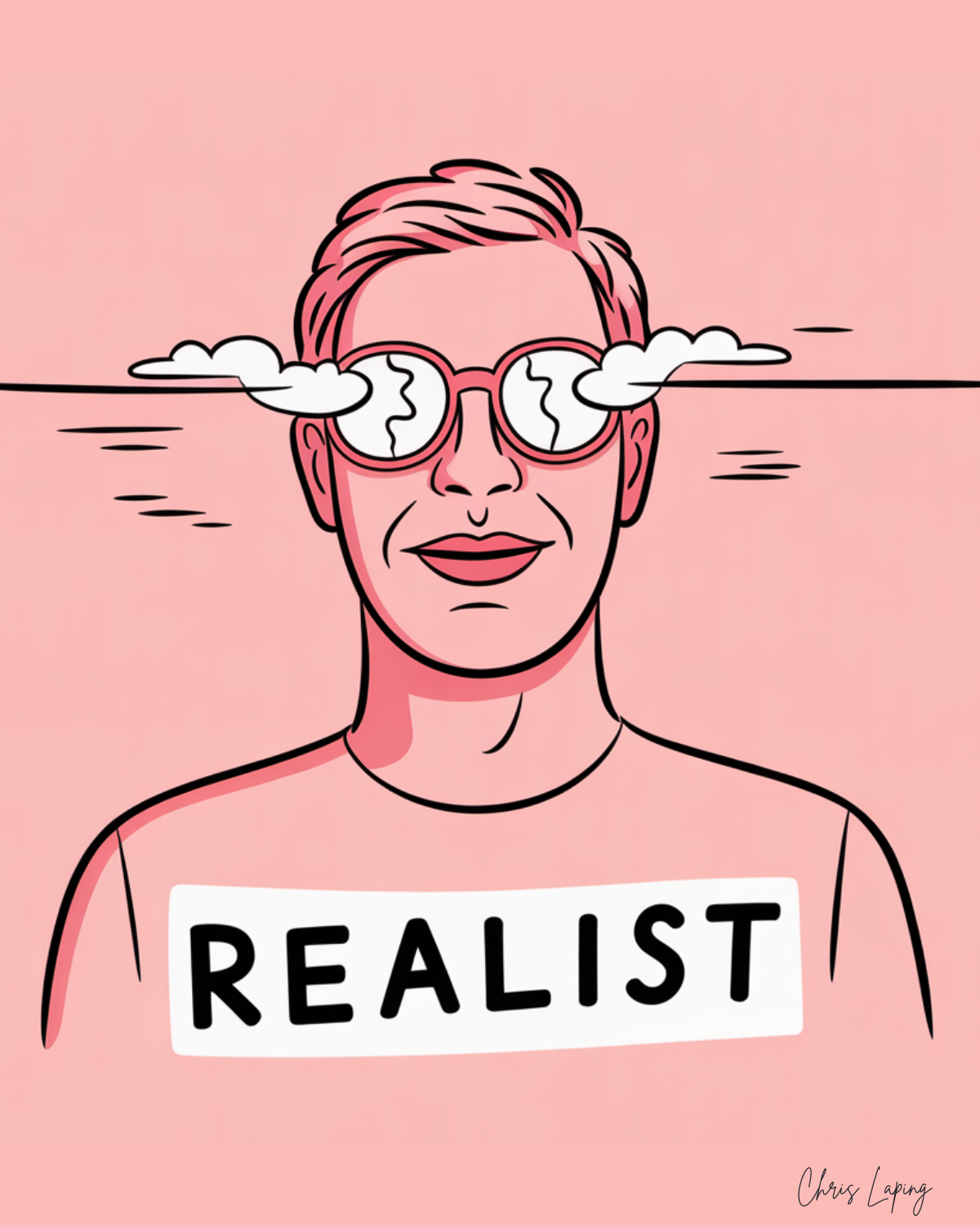
“I’m not an optimist or a pessimist. I’m a realist.”
It felt enlightened. Like I’d found the sweet spot between delusion and despair.
But here’s what I was actually saying: I see the world as it really is. And if you disagree with me, you’re the one with the distorted view.
No wonder people stopped responding to my ideas.
A psychologist named Lee Ross gave this phenomenon a name back in the 1990s: naïve realism. It’s the belief that we perceive the world objectively. That our views are based on reality, while others who disagree must be uninformed, irrational, or biased.
And here’s the kicker: the smarter we are, the more susceptible we become.
How naïve realism works against you
Harvard Professor Julia Minson has spent years studying the psychology of disagreement. Her research reveals something uncomfortable: when we encounter someone who disagrees with us, we don’t just think they’re wrong. We assume they’re fundamentally different from us. Less rational, less informed, maybe even less moral.
It’s not a conscious calculation. Our brains do it automatically.
In one study, Minson found that when people make estimates about things they know nothing about (like how many snow plows a city needs), they consistently give twice as much weight to their own judgment as to their partner’s. Even when both people are equally uninformed. Even when simple averaging would produce more accurate results.
Why? Because the further away someone’s estimate is from ours, the more we assume they’re just wrong.
This doesn’t just affect quantitative judgments. It shapes how we interpret every disagreement. When your colleague pushes back on your proposal, naïve realism whispers: They don’t get it. They’re not seeing what I’m seeing.
And once you believe that, you stop listening.
The trust erosion no one talks about
You know what happens when people sense you think you’re the only “realist” in the room?
They stop bringing you their real thoughts.
Not because they’re intimidated. Because they’ve learned it’s not worth it. Without meaning to, you’ve signaled that disagreement is evidence of their confusion, not useful input.
In my book Unignorable, I call out the mantras that seem wise but actually push people away. Such as, “I only use facts and data to make my decisions.”
Each one sounds rational. Each one subtly communicates: I’ve already figured this out. Your perspective is noise.
And each one makes you easier to ignore.
Try this
The next time you’re in a disagreement at work, at home, anywhere… try this internal question:
What if they’re seeing something I’m not?
Not “What if they’re right?” That’s a different question, and it triggers defensiveness. Just: What if there’s a piece of this I’m missing because of where I’m standing?
Minson’s research shows that simply being aware of naïve realism can make you more open to opposing views. Not because it changes your position, but because it creates space for genuine curiosity.
And curiosity is the antidote to dismissal.
One more thing
When my old CEO and I used to go round after round on decisions, I told myself I was “being direct” and “standing my ground.” What I didn’t realize: I was also signaling that his perspective was less valid than mine.
I wasn’t trying to shut him out. I was just convinced I was seeing things clearly.
He probably thought the same thing.
That’s naïve realism in action. Two smart people, both believing they’re the realist. Both wondering why the other won’t listen.
Maybe the real question isn’t who’s right?
Maybe it’s what am I missing by being so sure I’m not missing anything?
Your coach,
Chris
P.S. Struggling to get through to someone who seems convinced they’re the only one seeing clearly? Sometimes you need a thinking partner who isn't in the middle of it. Let’s meet.